NEWS
-

The 4th AVAS Scientific Meeting 2025: Internationally Recognized Research Achievements and Future Prospects
In the last part of this report on our experiences of participating in overseas academic conferences, I would like to introduce the results of our activities. The AMOR-VENUS study team, consisting of myself, Dr. Hideto Yasuda, Dr. Masahiro Kashiwaura, our medical staff, and myself as a member of J-IVCARES, conducted a study entitled "Impact of different peripheral venous catheter materials in the intensive care unit on the incidence of phlebitis.... -
[3rd] Experience of Participating in AVAS Scientific Meeting 2025: Latest Evidence Shows New Insights into Vascular Access Management
In this third installment of our overseas academic conference participation experience, we would like to introduce the Main Congress. The Main Congress featured important research presentations on evidence-based vascular access management. Parallel sessions were held on a wide variety of topics, including "Acute Care," "Prehospital and Emergency Medicine... -
Second] Experience of Participating in AVAS Scientific Meeting 2025: Exploring the Potential of Innovative Technology in Medical Education
In this second installment of our overseas conference participation experience, we would like to introduce the Pre-Congress Workshops. The Pre-Congress Workshop was held at the University of Wollongong with three parallel courses: Workshop 1, "Planning the Exit Site for Optimal Dressing and Securement...", Workshop 2, "Planning the Exit Site for Optimal Dressing and Securement...", and Workshop 3, "Planning the Exit Site for Optimal Dressing and Securement...". -
First] AVAS Scientific Meeting 2025 Participation Experience: To the Forefront of Vascular Access Research
This is a four-part series of reports on our experiences participating in overseas academic conferences. In this first installment, we will provide an overview of the conference we attended. Conference OutlineConference NameAVAS Scientific Meeting 2025 DatesSunday, July 20, 2025Pre-Congress WorkshopMonday, July 21, 2025Tuesday, July 22, 2025Main CongressOpening... -
Comparison by arterial line material Randomized controlled trial
This time it is a double-blind, randomized study of whether the incidence of catheter failure differs depending on the material of the arterial line. This is a double-blind randomized trial to determine whether the incidence of catheter failure differs depending on the material of the arterial line. The study ended early with a strong difference. Blood pressure monitoring with arterial catheters is an essential technique for hemodynamic assessment of critically ill patients in the ICU.... -
Comparison of Safety and Complications of PICC and Midline Catheters (Multicenter Cohort Study)
Midline catheter is a relatively new treatment method introduced in Japan in 2024. (It is inserted through a vein in the upper arm under echocardiography for patients who have difficulty securing an intravenous infusion and is said to be easier than PICC. -

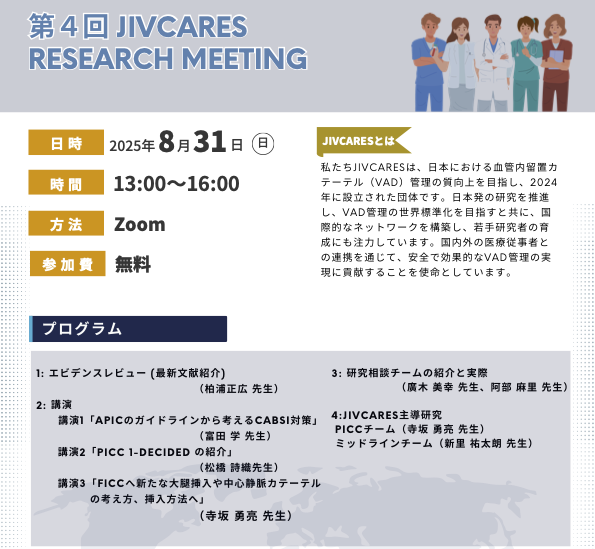
Announcement of the 4th JIVCARES Research Meeting
The Japanese Intravascular Catheterization Research Council of America (JIVCARES), an educational and research organization on catheter management, will hold a research meeting on August 31, 2025. The meeting will not only focus on research, but will also include an introduction to the latest literature and three educational lectures. We hope you will join us... -
Notice of Release of Japanese Translation of I-DECIDED
I-DECIDED is a device evaluation and decision-making tool developed by the AVATAR (Alliance for Vascular Access Teaching and Research) Group and others based at Griffith University in Australia. It allows nurses and other members of the health care team to evaluate PICC (Peripheral... -

Planned Activities at the 40th Annual Meeting of the Japanese Society of Environmental Infectious Diseases
The 40th Annual Meeting of the Japanese Society of Environmental Infectious Diseases will be held at Pacifico Yokohama from July 10 (Thu.) to 12 (Sat.), 2012. Five presentations related to VADs (Vascular Access Devices) by J-IVCARES board members are scheduled at this meeting. In addition, during the meeting, the NORTH 3rd floor non-operating... -
Midline catheter introduction with zero infection
A study to reduce unnecessary use of central venous catheters and safely introduce midline catheters in venous channeling device selection: a prospective, nurse-led, observational study at a 576-bed urban community hospital that evaluated their usefulness in terms of infection risk and treatment completion rates....