NEWS

The possibility of administering rivaroxaban prophylaxis to PICC-bound patients
In long-term indwelling central venous catheters, including PICC catheters, catheter-related thrombosis (CRT) is one of the significant complications. This article introduces a systematic review and meta-analysis examining the efficacy and safety of anticoagulation therapy aimed at preventing CRT in adult cancer patients....Failure and complications of peripheral arterial catheters in the ICU
In the management of hemodynamics in critically ill patients, the arterial pressure line (peripheral arterial catheter) is routinely used for continuous blood pressure measurement and frequent blood sampling. Central venous catheters (CVCs) are associated with significant complications of catheter-related bloodstream infections...CRBSI risk in the second CVC
In the management of critically ill patients, I imagine we experience cases where a central venous catheter is simultaneously placed in two places for purposes such as dialysis and parenteral nutrition (TPN). However, the specific numbers of how multiple insertions actually increase the risk of central venous catheter-related bloodstream infections (CLABSI) are unclear...
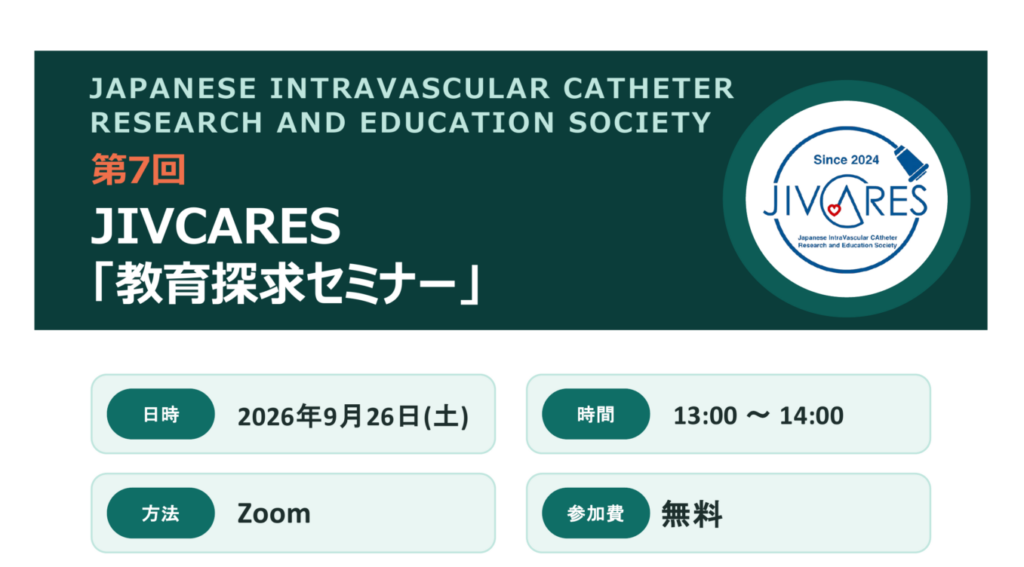
Notice of the 7th JIVCARES "Education Inquiry Seminar" (September 26, 2026 - Online)
JIVCARES is pleased to announce the 7th "Educational Inquiry Seminar" as detailed below. Event Overview Date and Time: Saturday, September 26, 2026, 13:00 - 14:00 Format: Zoom (Online) Registration Fee: Free Program The Journey of JIVCARES (Dr. Hideto Yasuda) Evidence Review: Introduction to the Latest Literature...
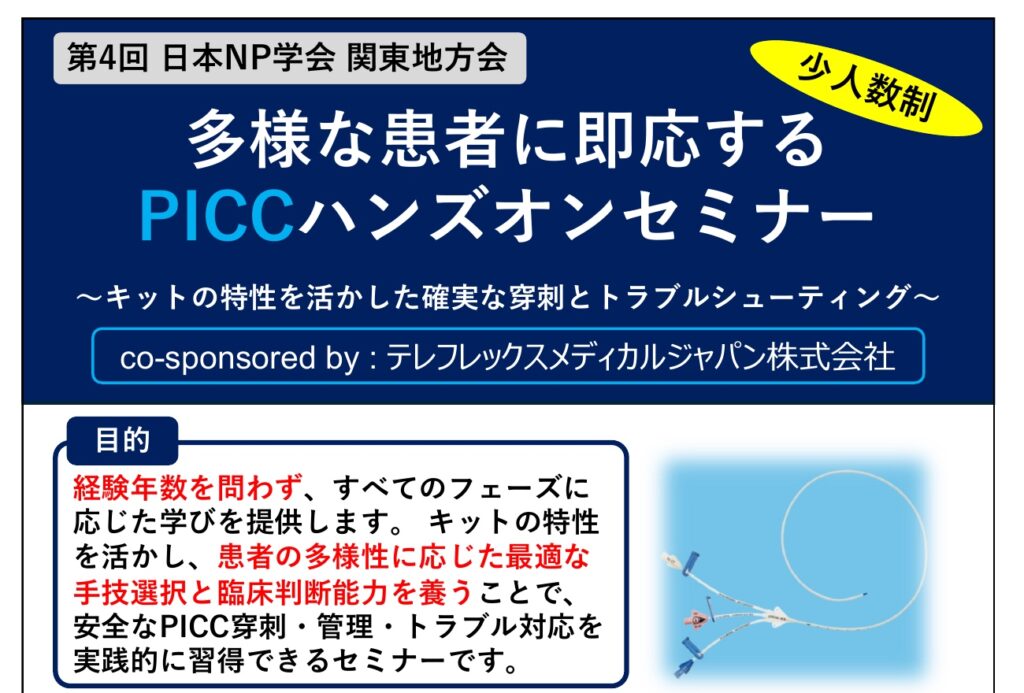
[Held on 9/19/2026, Small Group] PICC Hands-on Seminar for Responding Immediately to Diverse Patients (4th Kanto Regional Meeting of the Japanese Association of Nurse Practitioners)
On Saturday, September 19, 2026, we will hold the "PICC Hands-on Seminar for Responding Promptly to Diverse Patients" at the Kawasaki City Industrial Promotion Hall. Small group format, limited to 10 participants. This seminar is aimed at Nurse Practitioners (NPs), certified nurse practitioners, NP students, and trainees in certified nurse training courses.
APIC "Guide to the Prevention of Catheter-Associated Bloodstream Infections (CABSI) in Adults" Japanese Edition Released
The Japanese version of the "Guideline for the Prevention of Catheter-Associated Bloodstream Infections (CABSI) in Adults," published by the Association for Professionals in Infection Control and Epidemiology (APIC) in July 2025, has been released in the APIC resource library. This applies not only to central venous catheters, but to all vascular access devices (VADs), including peripheral ones...
[First in Japan] ANTT® Official Japanese Version Manual Released
J-IVCARES has released the official Japanese version of Aseptic Non-Touch Technique (ANTT®) and its procedural manual. This marks the first time the Japanese version of ANTT® has been published in Japan. What is ANTT®? ANTT® is a technique developed by the Association for Safe Asepti...
Qualitative Study on Difficulties in PIVC Insertion
When considering the selection and management of vascular access devices (VADs), "quantifiable indicators" such as complication rates, costs, and dwell times from a healthcare professional's perspective are likely to lead to important evidence. However, the peripheral intravenous catheter (PIVC) insertion itself, for patients and their families, is...Peripheral Intravenous Catheter (PIVC) Complications
In your facility, how often do peripheral intravenous catheters (PIVCs) cause problems? Isn't it a daily occurrence in the field to experience things like, "I just inserted it, and it's already clogged," "It's swollen again," or "How many have I put in today...?" What we'll introduce this time is...Central venous catheter insertion site options
In our institution's intensive care unit, the internal jugular vein remains the first choice for central venous catheter insertion. In cases requiring catheter replacement due to complications, the contralateral internal jugular vein and the femoral vein are used. The subclavian vein is less favored due to the incidence and severity of mechanical complications...