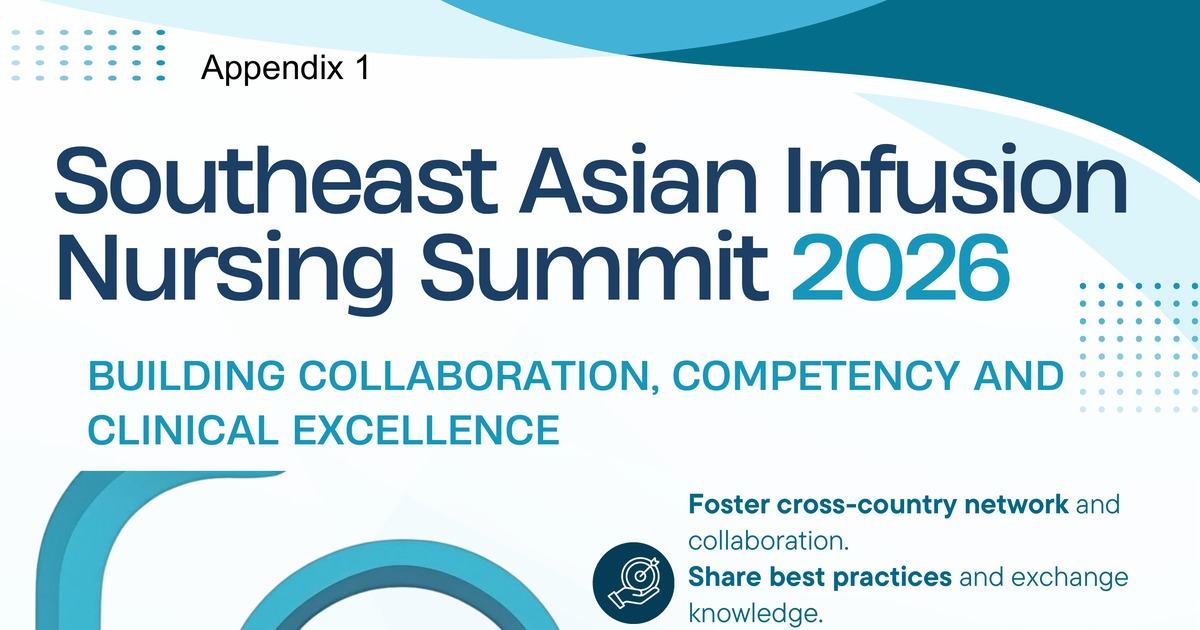
date(s) (e.g. for exhibition):March 25 (Day 1) and 26 (Day 2), 2026
Venue: Bangkok, Thailand
Grande Centre Point Ratchadamri / Bangkok Metropolitan Administration General Hospital
Summit Outline
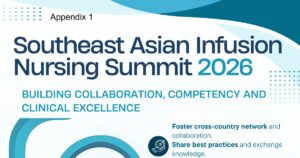
The "MARCH 25-26, 2026" event will be held in Bangkok, Thailand, on March 25 and 26, 2026.Southeast Asian Infusion Nursing Summit 2026was held.
The theme is "Building Collaboration, Competency and Clinical Excellence". This international conference aimed to develop infusion nursing in the Southeast Asian region and provided a venue for professional organizations from various countries to work together to improve the quality of infusion therapy through sharing clinical practice, education, and research.
Organized by Thailand'sInfusion Nurse Network Association (INNA)and sponsored by Terumo Medical Care Solutions, Inc. Leaders and researchers in infusion nursing from Malaysia, Indonesia, Singapore, Japan, and other countries participated.
Program Overview
Day 1 (March 25): Sharing of best practices and workshops in each country
Country Best-Practice Presentations" by representatives from Thailand (INNA), Malaysia (INSM), Indonesia (INA PERSAI), Singapore (INSS), and Japan (J-IVCARES) were presented.
In the afternoon, a panel discussion was held by representatives from each country, where they actively exchanged opinions on issues common to all countries, such as infection prevention, standardization of procedures, and implementation of guidelines.
In addition, "theBuilding Competency Framework for Infusion NursesIn an interactive workshop on the theme of "The Competency Domain," participants were divided into cross-country groups to brainstorm and discuss the four competency domains.
Competency domains (4 areas)
- Legal and Ethical Nursing Practice
- Professional Nursing Practice
- Collaborative Practice & Teamwork
- Continuing Professional Education & Development
Day 2 (March 26): Hospital tour
On the second day, the group visited the Bangkok Metropolitan Administration General Hospital (Klang Hospital). The hospital is known as a Center of Excellence for infusion therapy, and the participants observed and discussed protocols and ongoing training systems. At the closing ceremony, a "Regional Action Plan" was presented based on the results of the Day 1 workshop.
Participation from Japan
From Japan,J-IVCARES(一般社団法人 日本血管内カテーテル研究協議会)The following two individuals participated and presented online on behalf of the
| speaker | belong to | Presentation Theme |
|---|---|---|
| Dr. Hideto Yasuda(Representative Director) | Associate Professor, Department of Emergency and Intensive Care Medicine, Saitama Medical Center, Jichi Medical University | Reconstructing Intravascular Catheter Management in Japan |
| Hirotaka Sakai | Associate Professor, Department of Nursing, Fujita Medical College / Clinical Nurse Practitioner (NP) | Competency Framework for Infusion Nurse in Japan |
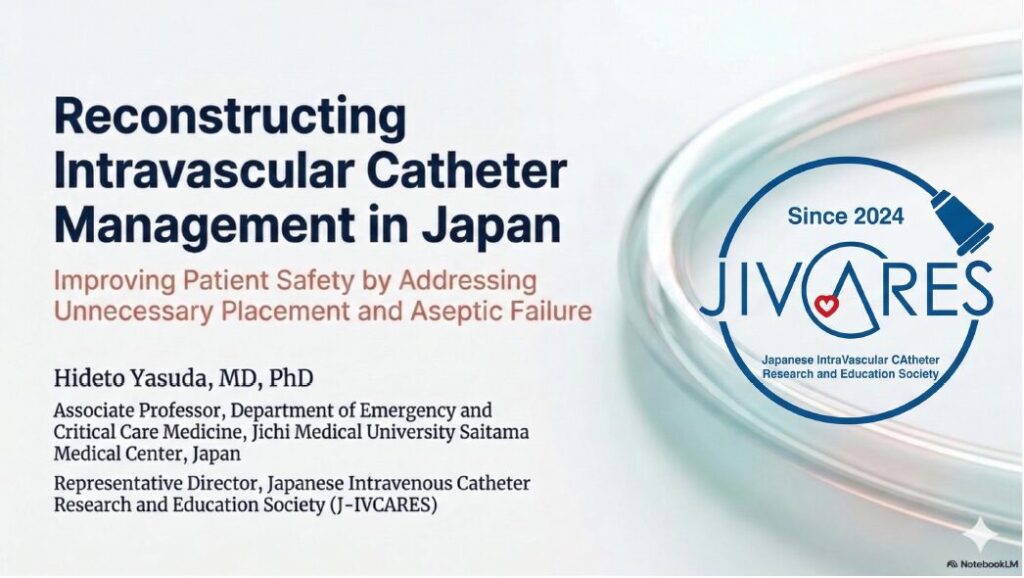
Lecture by Dr. Hideto Yasuda
Reconstructing Intravascular Catheter Management in Japan
Background of the presentation and issues raised
Dr. Yasuda presented the current status and challenges of intravascular catheter management in Japan. He pointed out that peripheral intravenous catheterization (PIVC) is often perceived as a "simple procedure" and therefore the risks are often overlooked.
PIVCs are invasive devices with complications such as infection and phlebitis, which can seriously affect patient safety if not properly managed.
Two important perspectives presented
Two essential issues in catheter management were raised in the lecture
- Reduction of Unnecessary indwelling
- Thorough aseptic manipulation (prevention of Breach of asepsis)
Introduction of specific practical methods
The following tools and techniques were presented to address these issues
- I-DECIDED.: an assessment tool to systematically evaluate the ongoing need for catheters
- ANTT (Aseptic Non Touch Technique)Practical Framework for Aseptic Non-Contact Technology
Based on his research experience at the AVATAR Group in Australia, Dr. Yasuda has been working on the integration of research, education, and clinical practice.systematic approachHe emphasized the importance of the "Japan-Japan Forum" (JFIF). He suggested that it is urgent to establish a domestic platform covering the whole of Japan.
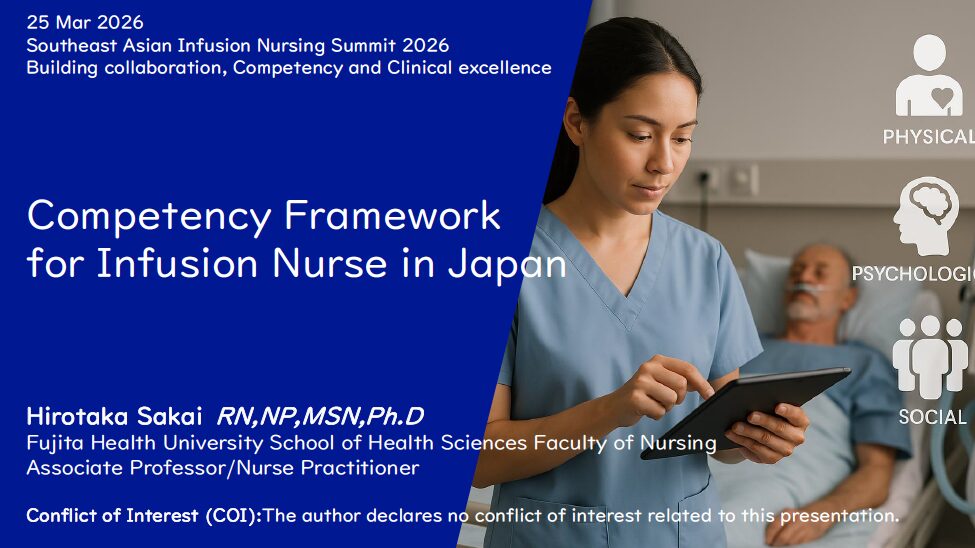
Presentation by Dr. Hirotaka Sakai
Competency Framework for Infusion Nurse in Japan
Expanding Role of Japanese Nurses and Educational System
Sakai, as background to the expanding role of nurses in Japan,Training System for Specific ActionsandNurse Practitioner (NP) SystemThe presentation provided an overview of He indicated that these systems are also an important foundation in the professional development of infusion catheter management.
Competency Development Structure
Using the 2025 Standards of Practice for Infusion Catheter Management as a foundation, the following step-by-step educational and assessment model was described
- Step-by-step education based on career ladderSystematic learning design according to proficiency level
- Simulation Education/OSCEObjective Evaluation Methods for Technical Acquisition
- Continuing education (post-graduate education): Continuous maintenance and improvement of skills in clinical settings
Practice Model at Fujita Medical University Hospital
As a specific example of IV training, the educational program at Fujita Medical College Hospital was introduced. The training model, which integrates education, evaluation, and clinical practice, was received with great interest by delegates from various countries. This presentation provided a valuable opportunity to share the Japanese educational model internationally in the discussion of building a competency framework in the Southeast Asian region.
Summit Outcomes and Future Prospects
Throughout this summit, we will discuss how to improve the quality of infusion therapy by "improving theAn approach integrating guidelines, education, and clinical practiceIt was reaffirmed that it is essential to
The following themes were shared as issues common to each country, and the need for international collaboration was strongly recognized.
- Standardization of Education
- Uniformity of quality of procedures and management
- Thorough infection prevention
based on the results of the Day 1 workshop.Regional Action Planwas formulated and an agreement was reached to follow up on a regular basis in the future.
J-IVCARES Initiatives
Based on the discussions at the Summit, J-IVCARES will continue to contribute to improving the quality and safety of vascular access management and infusion therapy in Japan through the following activities.
- Dissemination of I-DECIDED and ANTT: Supporting the nationwide implementation of evaluation tools and aseptic techniques
- Establishment of a domestic databasePromoting Evidence-Based Practice
- Standardization of educational programsDevelopment of systematic infusion nursing education
- Strengthening International CollaborationContinuous networking with Southeast Asian countries
For inquiries regarding this article, please contact J-IVCARES.
Comments