
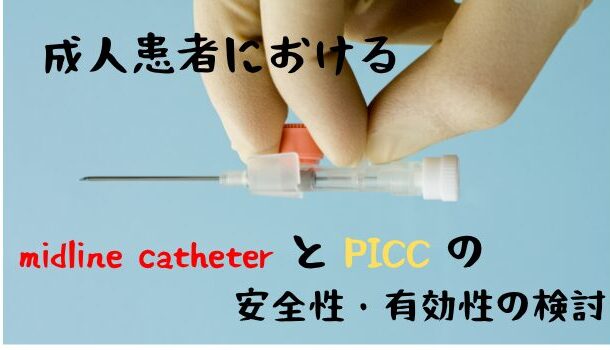
Recent years,midline catheteris attracting attention as a device that is less invasive than PICC (peripherally inserted central catheter) and is expected to reduce the risk of central venous catheter-related bloodstream infection (CRBSI). On the other hand, in reality,"Is it really safer than a PICC?" and "Are there fewer complications?"Regarding these points, there was insufficient evidence from sufficient randomized controlled trials (RCTs).
This time, we'll introduce an RCT that directly compares the safety and efficacy of midline catheters and PICCs in adult patients.
[Review Article]
Safety and Efficacy of Midline vs. Peripherally Inserted Central Catheters in Adults Receiving Intravenous Therapy: A Randomized Clinical Trial
Thomsen SL, et al.
JAMA Network Open. 2024;7(2):e2355716.
doi:10.1001/jamanetworkopen.2023.55716
https://pmc.ncbi.nlm.nih.gov/articles/PMC10865154/
Background
Although peripheral intravenous catheters are widely used, they often need to be replaced every 3 to 4 days, and for mid- to long-term infusions, PICC or central venous catheters may be selected. On the other hand, midline catheters are inserted into large veins in the upper arm, are shorter than PICCs, and are devices whose tips do not reach the central veins. They are positioned as an "intermediate option between peripheral lines and PICCs."
Although their use has increased in recent years due to improvements in insertion techniques and catheter materials, existing research has suggested a "low possibility of infection risk" while also reporting a "possibility of increased complications," leaving the actual safety assessment unclear.
This study was conducted to directly compare midline catheters and PICCs in adult patients requiring 5 to 28 days of intravenous treatment, verifying their safety and efficacy.
【Method】
・Research Design: Single-center randomized controlled trial (RCT)
・Subject: 304 adult patients requiring intravenous treatment for 5-28 days
Grouping
- Midline catheter (MC) group: 152 patients
PICC Group: 152 individuals
Primary endpoint
Catheter-related bloodstream infection (CRBSI)
・Secondary endpoints:
Deep vein thrombosis (DVT)
- Catheter-related complications
Early removal of catheter
・Phlebitis, infiltration, pain, leakage, etc.
・Follow-up period: Up to 90 days after completion of treatment
[Result]
CRBSI (Catheter-Related Bloodstream Infection)
MC group: 0 cases
・PICC group: 1 case
No significant difference between the two groups (P > .99)
Catheter-related complications
・MC group: 20 cases (13.21 TP3T)
・PICC group: 11 cases (7.21 ± 3.0)
significantly higher in the MC group
(IRR 2.37, 95% CI 1.12–5.02, P = .02)
Early removal rate
・MC Group: 13.21 TP3T
・PICC group: 6.61 TP3T
→ MC group, high rate
■ Major Complications
Leak
Accidental removal
Obstruction
Infiltration
"Minor complications" such as these were more frequently observed in the MC group.
Analysis by Period of Detention
No significant difference in complication rates was observed with indwelling times of less than 16 days.
On the other hand, after 16 days, complications and early removal increased in the MC group.
Conclusion/Summary
This study showed no difference in the incidence of CRBSI between midline catheters and PICCs, indicating that both can be used safely.
On the other hand, it was revealed that midline catheters have more catheter-related complications compared to PICCs, and particular caution is needed for prolonged indwelling of 16 days or longer. However, many of the complications were minor, such as leakage and occlusion, with very few severe infections or thromboses.
This study provides the important suggestion that "while a midline can be expected to reduce infection risk, mechanical complications may increase with longer indwelling periods."
This can be considered one of the important pieces of evidence for selecting an appropriate device based on "treatment duration," "administered drugs," and "patient background" when considering the VAD selection protocol at your facility in the future.

Sign up for the mailing list 👇
Comments